Introduction
Europe stands at a critical juncture in its energy transition. As electricity prices surge across the continent—with Germany paying €38.40 per 100 kWh in 2025, nearly six times higher than Turkey —European homeowners are seeking innovative solutions to reduce their energy bills and gain independence from volatile grid prices.
Enter the balcony energy storage system: a game-changing technology that combines portable solar panels with intelligent battery storage, enabling apartment dwellers and homeowners to generate and store their own electricity. What was once a niche market is now experiencing explosive growth, with the global balcony energy storage systems market valued at USD 330 million in 2025 and projected to reach USD 1.24 billion by 2033 .
But why is Europe leading this revolution? And what does this mean for the future of residential energy?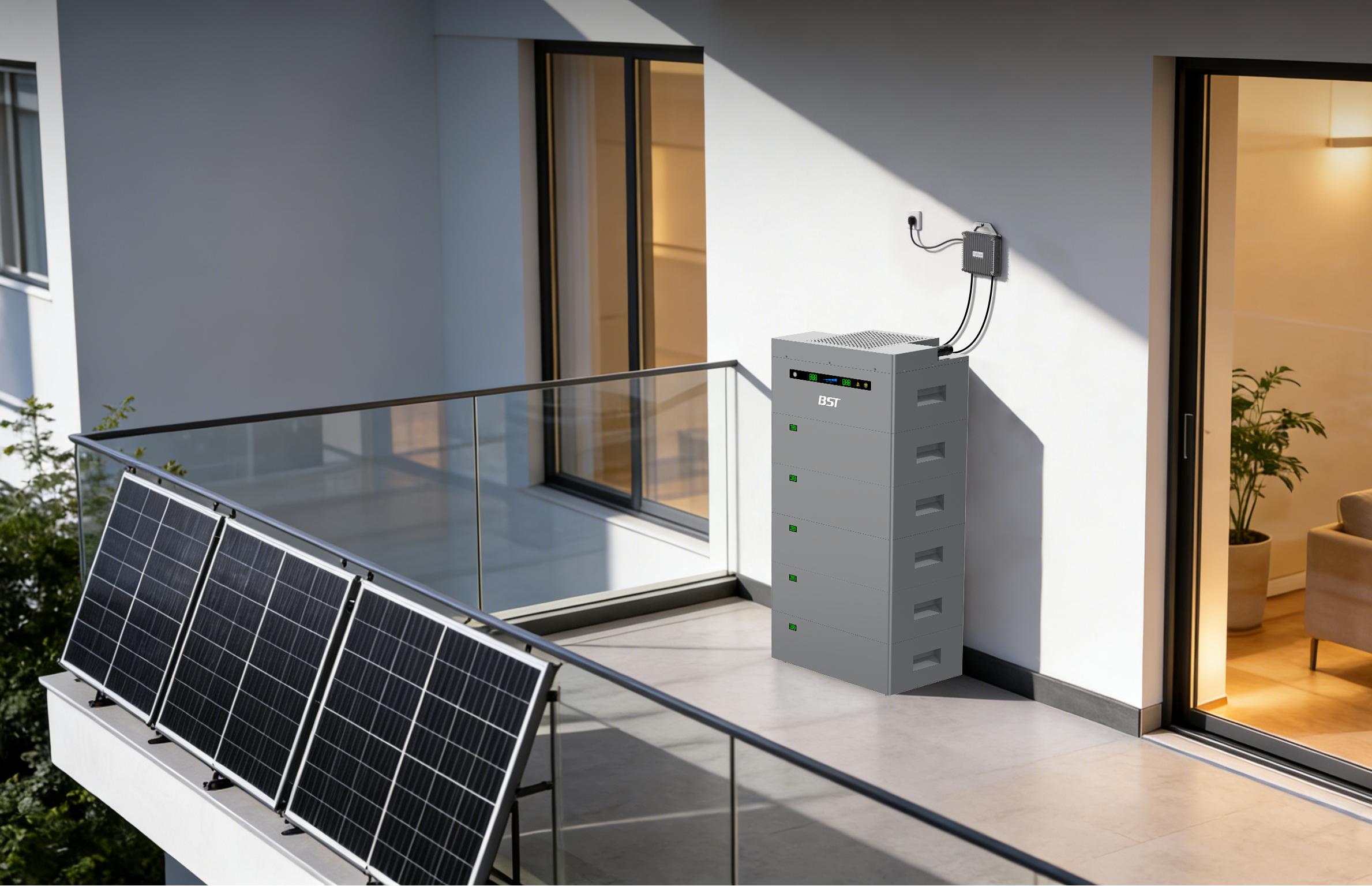
The European Energy Crisis: A Catalyst for Change
Rising Electricity Costs Drive Demand
The 2021-2022 European energy crisis fundamentally changed how consumers view their energy consumption. While electricity prices have moderated from their 2022 peaks, they remain significantly elevated compared to pre-crisis levels. In the first half of 2025, household electricity prices across the EU ranged from €6.20 to €38.40 per 100 kWh, with Germany, Denmark, and Belgium among the most expensive markets .
This price volatility has created an unprecedented opportunity for residential energy storage solutions. European households are no longer passive consumers accepting whatever the grid provides. Instead, they’re actively seeking ways to:
•Reduce energy bills by storing cheap electricity during off-peak hours
•Maximize solar generation by capturing every kilowatt of renewable energy
•Achieve energy independence from volatile wholesale markets
•Ensure resilience against future price shocks and grid disruptions
The Renewable Energy Paradox
Interestingly, Europe’s surge in renewable energy capacity has created a new challenge: oversupply during peak generation hours. In 2025, Europe recorded unprecedented negative electricity prices as solar and wind output outpaced demand, with grid operators actually paying consumers to use electricity during certain hours .
This paradox highlights a critical insight: the problem isn’t generating renewable energy—it’s storing and using it efficiently. Balcony energy storage systems solve this equation by enabling homeowners to capture cheap (or free) renewable electricity and use it when prices are high.
Market Growth: The Numbers Behind the Boom
Explosive Market Expansion
The European balcony solar system market tells a compelling story of rapid adoption:
•Market Size (2024): €445 million (38% of global market)
•Projected Size (2026): €762.65 million
•Projected Size (2035): €2.73 billion
•Compound Annual Growth Rate (CAGR): 15-18% through 2033
This growth significantly outpaces traditional residential battery storage, which grew at 17.2% CAGR during 2023-2030 . The difference? Balcony systems require no installation, no permits, and no professional electricians—making them accessible to renters and apartment dwellers who represent a massive untapped market.
Adoption Rates Tell the Real Story
The adoption trajectory is even more impressive when measured by installed systems:
•June 2024: Over 1 million registered balcony systems across Europe
•Expected (H1 2025): Additional 300,000 systems installed
•Projection (2025-2030): Millions more as awareness and affordability improve
Germany leads adoption with approximately 400,000+ systems, followed by Austria, France, and the Netherlands. However, emerging markets in Eastern Europe, Spain, and Italy represent the next growth frontier.
Why Europe Needs Balcony Energy Storage Now
1. Apartment Living Dominance
Unlike the United States, where single-family homes with rooftops dominate, Europe has a fundamentally different housing structure. Approximately 60% of Europeans live in apartments or flats , making traditional rooftop solar inaccessible to the majority of the population.
Balcony energy storage systems democratize renewable energy, enabling:
•Apartment dwellers to generate their own power
•Renters to invest in energy solutions without landlord approval
•Urban residents to participate in the energy transition
•Multi-family buildings to achieve collective energy independence
2. Energy Security and Geopolitical Concerns
Europe’s energy independence remains fragile. The continent’s reliance on imported gas and electricity creates vulnerability to geopolitical disruptions. Residential energy storage—even at the balcony level—contributes to:
•Distributed resilience: Thousands of small storage systems create a more robust grid
•Reduced import dependency: Every kilowatt generated locally reduces reliance on imports
•Grid stability: Distributed storage helps balance renewable intermittency
•Consumer empowerment: Households gain control over their energy destiny
3. Climate Commitments and Regulatory Support
The European Union’s commitment to climate neutrality by 2050—and the intermediate target of 55% emissions reduction by 2030—has created a supportive regulatory environment for residential renewables.
Key policy drivers include:
•EU Renewable Energy Directive (RED IV): Encourages prosumers (consumers who produce energy) and community energy
•National Feed-in Tariffs: Many countries offer favorable rates for excess solar generation
•Simplified Permitting: Several EU countries have streamlined approval processes for balcony systems
•Tax Incentives: Germany, Austria, and other nations offer tax breaks for renewable energy investments
4. Technological Maturity and Cost Reduction
Battery costs have plummeted 89% since 2010, with LiFePO₄ (lithium iron phosphate) batteries now offering:
•Superior safety profiles
•6,000+ cycle lifespans (15+ years of daily use)
•Excellent temperature performance
•Recyclability and environmental responsibility
This cost reduction has made balcony energy storage economically viable for middle-income households, not just wealthy early adopters.
The Balcony Energy Storage Solution: How It Works
System Components
A typical balcony energy storage system comprises:
1.Portable Solar Panels (200-400W each)
•Lightweight and weatherproof
•Quick-connect installation
•No structural modifications required
2.Intelligent Battery Storage (5-20 kWh)
•Compact, stackable design
•Built-in inverter and charge controller
•Smart management algorithms
3.Smart Control System
•Real-time monitoring via mobile app
•Automated charging/discharging optimization
•Grid interaction capabilities
•Weather forecasting integration
Real-World Benefits
Case Study: German Household
A typical German household using a balcony energy storage system can:
•Generate 1,500-2,000 kWh annually from balcony solar
•Store 5-10 kWh daily for evening/night use
•Reduce grid electricity consumption by 30-40%
•Save €400-800 annually on electricity bills
•Achieve payback in 6-8 years
•Enjoy 15+ years of clean, free energy
BST Power: Leading the Balcony Storage Revolution
The BST Power Advantage
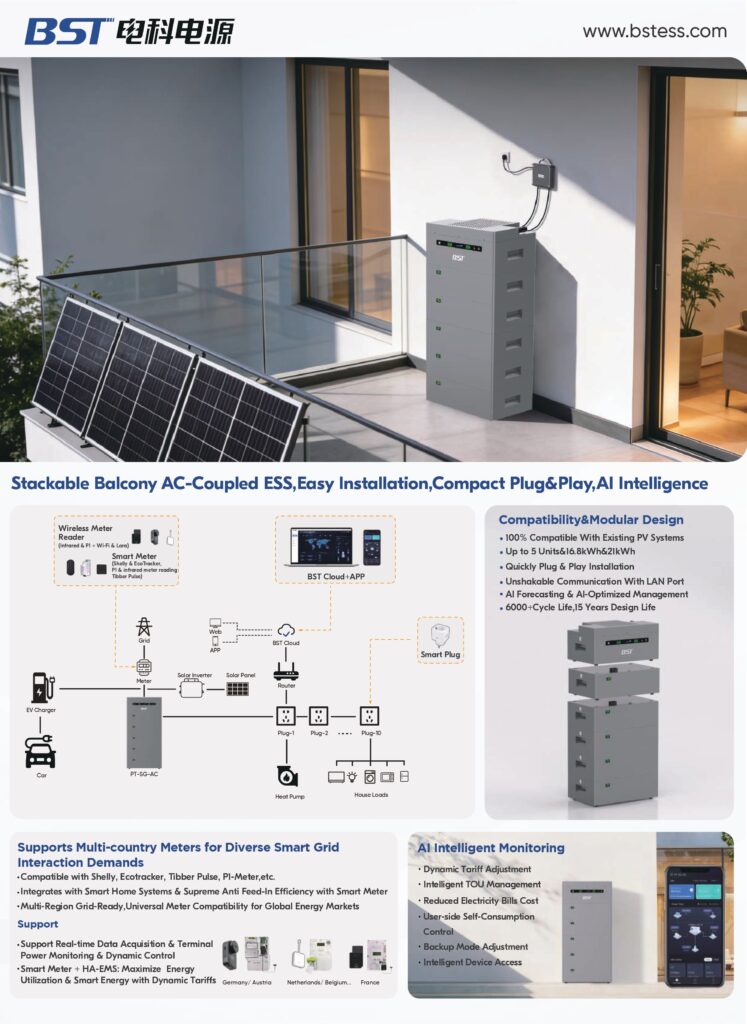
Recognizing Europe’s urgent need for accessible, intelligent energy storage, BST Power has developed a next-generation balcony energy storage system that addresses the continent’s unique challenges.
Key Features:
1. Universal Compatibility
•Works with single-phase and three-phase electrical systems
•Compatible with existing solar installations
•Integrates with smart home systems
•Supports grid-interactive and off-grid operation
2. Modular Scalability
•Start small with 2.8 kWh/3.5kWh capacity
•Expand to 20+ kWh as needs grow
•Stack multiple units for whole-home backup
•No need to replace the entire system
3. Intelligent Energy Management
•AI-powered optimization algorithms
•Predictive weather forecasting
•Time-of-use rate optimization
•Automatic load shedding during grid stress
•Real-time mobile app monitoring
4. Installation Simplicity
•Plug-and-play design
•No professional installation required
•Balcony mounting in under 2 hours
•Instant grid connection
•Renter-friendly (no permanent modifications)
5. European-Focused Design
•Optimized for European climate conditions
•Supports European grid standards
•Compliant with EU safety certifications (CE, UL 9540, IEC 62619)
•Multilingual app support
•Local customer support network
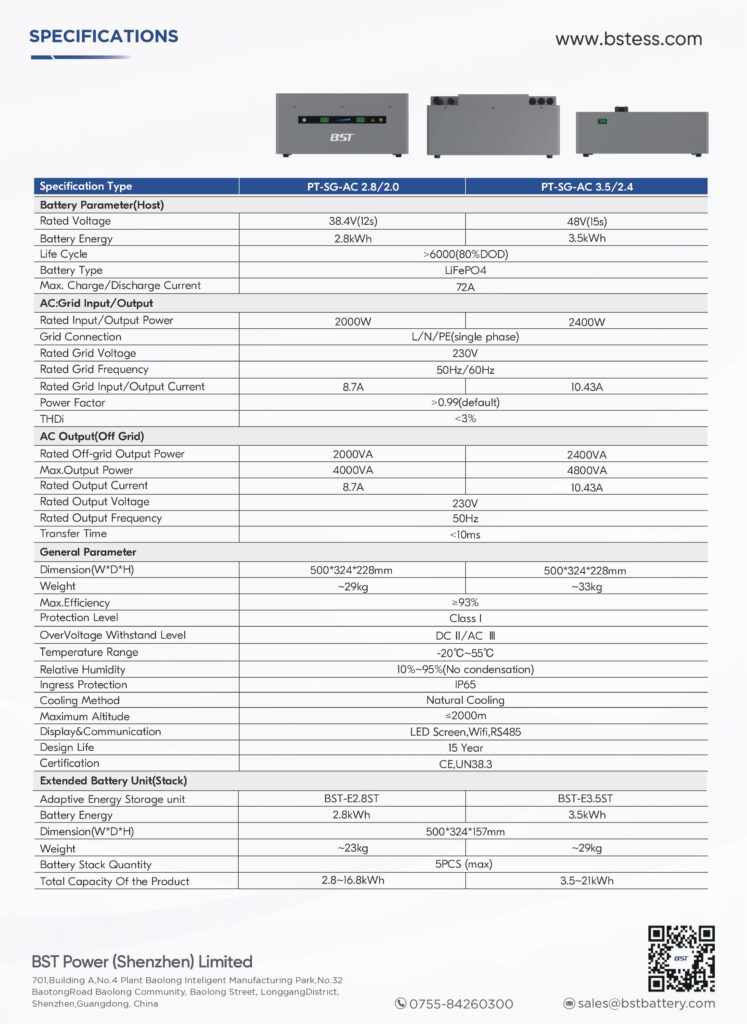
Performance Specifications
| Specification | BST Power /Stackable Balcony AC-Coupled ESS |
| Solar Panel Output | 2000-2400W (expandable) |
| Battery Capacity | Up to 5 units&16.8kWh&21kWh |
| Battery Chemistry | LiFePO₄ (LFP) |
| Cycle Life | 6,000+ cycles (15+ years) |
| Grid Connection | L/N/PE(single phase) |
| Battery Energy | 2.8kWh/3.5kWh |
| Operating Temperature | -20°C to +55°C |
| Ingress Protection | IP65 |
| Smart Features | WiFi, AI intrlligence |
| Mobile App | iOS/Android with real-time monitoring |
Real-World Performance: European Markets
Germany: Households save €500-900 annually while reducing grid dependency by 35-45%
Austria: Apartment dwellers achieve complete energy independence during summer months
Netherlands: Systems provide backup power during grid stress events, with payback in 7-8 years
France: Integrates seamlessly with existing solar installations, maximizing renewable generation
Spain: High solar irradiance enables 2,000+ kWh annual generation, reducing bills by 40%+
Market Trends Shaping the Future
1. Increasing Apartment Adoption
As awareness spreads, apartment dwellers represent the fastest-growing market segment. Renters, in particular, appreciate balcony systems because they require no landlord approval and can be removed when relocating.
Trend Impact: Apartment-focused marketing and financing options will become increasingly important.
2. Community Energy Systems
Beyond individual balcony systems, neighborhoods and apartment complexes are exploring shared energy storage solutions that pool resources and optimize collective consumption.
Trend Impact: Regulatory frameworks supporting community energy will accelerate adoption.
3. Integration with Vehicle-to-Grid (V2G) Technology
As electric vehicle adoption accelerates, V2G technology enables EVs to serve as mobile energy storage, complementing stationary balcony systems.
Trend Impact: Integrated home-vehicle energy systems will become standard within 3-5 years.
4. Artificial Intelligence and Predictive Analytics
Next-generation systems will use AI to predict energy prices, weather patterns, and consumption behaviors, automatically optimizing storage and discharge cycles.
Trend Impact: AI-powered optimization could increase savings by 15-25% compared to current systems.
5. Regulatory Harmonization
The EU is working toward harmonized standards for prosumers and community energy, reducing regulatory complexity across member states.
Trend Impact: Simplified permitting will accelerate adoption in previously restrictive markets.
Economic Impact: Who Benefits?
Households
•Immediate: 20-30% reduction in electricity bills
•Long-term: Energy cost protection against future price increases
•Intangible: Peace of mind and energy independence
Energy Providers
•Grid Stability: Distributed storage reduces peak demand
•Flexibility: Aggregated balcony systems provide grid services
•Customer Retention: Prosumers remain engaged with energy transition
Governments
•Climate Goals: Accelerated renewable energy adoption
•Energy Security: Reduced import dependency
•Economic Growth: New jobs in installation, maintenance, and support
•Grid Resilience: Distributed storage improves system reliability
Manufacturers
•Market Expansion: Growing addressable market (60% of Europeans in apartments)
•Revenue Growth: Balcony systems market growing 15-18% annually
•Innovation Opportunities: Integration with EVs, smart grids, and AI
Challenges and Solutions
Challenge 1: Regulatory Fragmentation
Problem: Different EU member states have varying rules for prosumers, grid connection, and feed-in tariffs.
Solution: EU harmonization efforts and national regulatory reforms are simplifying the landscape. BST Power systems comply with all major EU standards, ensuring compatibility across markets.
Challenge 2: Grid Integration Complexity
Problem: Connecting distributed storage to the grid requires sophisticated management.
Solution: Intelligent control systems like BST Power’s handle grid interaction automatically, with real-time communication and compliance monitoring.
Challenge 3: Battery Recycling and Sustainability
Problem: End-of-life battery management is critical for environmental responsibility.
Solution: LiFePO₄ batteries have 95%+ recyclability rates. Manufacturers are establishing take-back programs and circular economy models.
Challenge 4: Consumer Education
Problem: Many Europeans don’t understand balcony energy storage or its benefits.
Solution: Targeted education campaigns, simplified product designs, and transparent ROI calculators are improving consumer awareness.
The Path Forward: Europe’s Energy Future
2026-2030: Mainstream Adoption
•Balcony systems become standard in apartment buildings
•Prices drop another 20-30% due to scale and competition
•Regulatory frameworks stabilize across EU
•Integration with EVs becomes common
•Community energy initiatives proliferate
2030-2035: Market Maturity
•10+ million balcony systems installed across Europe
•Balcony storage becomes expected amenity in new apartments
•AI-powered optimization becomes standard
•Grid services from distributed storage become economically significant
•Second-life batteries from EVs feed into balcony systems
2035+: Energy System Transformation
•Distributed storage plays critical role in grid stability
•Fossil fuel generation largely replaced by renewables + storage
•Households achieve near-complete energy independence
•Prosumers actively participate in energy markets
•European energy security fundamentally transformed
Conclusion: The Balcony Revolution Is Here
Europe’s balcony energy storage revolution isn’t just about technology—it’s about empowerment. It’s about giving 400 million apartment dwellers the ability to participate in the energy transition. It’s about reducing energy costs for households struggling with inflation. It’s about building a more resilient, secure, and sustainable energy system.
The market data is clear: balcony energy storage is experiencing explosive growth, with the market projected to grow from €445 million in 2024 to €2.73 billion by 2035. This isn’t a niche trend—it’s a fundamental shift in how Europeans generate and consume energy.
Solutions like BST Power’s intelligent balcony energy storage system are at the forefront of this revolution, combining modular scalability, intelligent management, and European-focused design to meet the continent’s urgent need for accessible, affordable energy independence.
For European households, the question is no longer “Should I invest in balcony energy storage?” but rather “When will I make the switch?”
The answer is simple: now is the time.
Key Takeaways
✅ Market Opportunity: €330M (2025) → €1.24B (2033)
✅ Adoption Rate: 1M+ systems installed; 300K+ annually
✅ Cost Savings: 30-40% reduction in electricity bills
✅ Payback Period: 6-8 years for typical households
✅ Market Growth: 15-18% CAGR through 2033
✅ European Focus: 60% of Europeans live in apartments (addressable market)
✅ Policy Support: EU renewable energy directives and national incentives
✅ Technology Maturity: LiFePO₄ batteries offer 15+ year lifespan
About BST Power
BST Power is a leading provider of intelligent energy storage solutions for European households. Our mission is to democratize energy independence by making advanced battery storage technology accessible, affordable, and easy to use for everyone.
Learn More:
•Website: www.bstess.com
•Contact: sales@bstbattery.com
•Demo: Schedule a free consultation